
Introduction
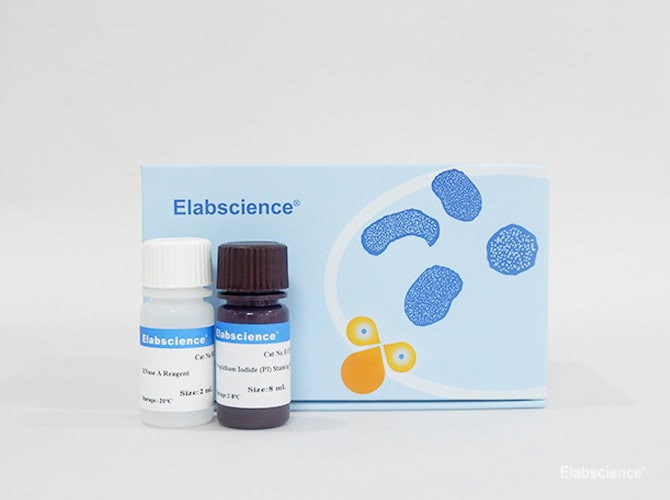
Elabscience® Caspase 3 Activity Assay Kit can detect the activity of Caspase 3 in cells or tissue lysis.
Caspase (cysteine-requiring aspartate protease) is a family of proteases that plays an important role in the apoptosis process. Caspase 3 (also known as CPP32, Yama, or apopain) is a member of the CED-3 subfamily of caspases and is one of the critical apoptosis enzymes. Caspase 3 is the most studied caspase in mammalian cells.
Caspase 3 can be used to cut proCaspase2, 6, 7, 9 and specifically cut many caspase substrates directly, including PPAR (poly ADP-ribose), the inhibitor of caspase-activated deoxyribonuclease (ICAD), gelsolin, and fodrine.
Caspase 3-mediated protein shearing is an important part of the molecular mechanism of apoptosis. Furthermore, caspase 3 also plays a key role in the nuclear apoptosis process, including chromatin condensation and DNA fragmentation, as well as blistering in cells. Caspase 3 exists as a proenzyme in the normal state and has no activity.
However, during the apoptosis stage, activated Caspase 3 consists of two large subunits and two small subunits, cleaving the corresponding endochilemma or cytoplasmic nucleus substrate and ultimately leading to apoptosis.
This kit is used to conjugate Caspase 3 sequence-specific acetyl-Asp-Glu-Val-Asp p-nitroanilide (Ac-DEVD-PNA) peptides with the yellow p-nitroaniline (PNA) group. When the substrate is cut by Caspase 3, the PNA of the yellow group dissociates. PNA has an absorption peak at 405 nm. Measure the OD value at 405 nm and then Caspase 3 activity can be calculated accordingly.
Storage
Store at -20°C. Ac-DEVD-pNA[E-CK-A311C] should be stored in dark. Avoid freeze/thaw cycles.
Note
1: For maximum assay performance, this reagent should be used within 12 months. Avoid freeze/thaw cycles.
2: There is a reducing agent (DTT) in the lysis buffer. The Elabscience® Total Protein (TP) Colorimetric Assay Kit (Coomassie Brilliant Blue Method) is recommended (Elabscience® E-BC-K168-S recommended) to measure protein concentration instead of the BCA method.
3: It has been reported that Caspase 3 activity cannot be detected in a few types of apoptosis, which may be due to the existence of an independent mechanism of Caspase 3 activation, and other signaling pathways in the apoptosis mechanism. needs to be considered. In this case, there is no significant change in Caspase 3 activity when using this kit.
4: The lysis buffer from this kit can be used in other Elabscience® caspase activity assay kits. And the protein sample can test other caspase activity.
5: pNA (4-nitroaniline) is toxic. Please be careful when operating and pay attention to effective protection to avoid direct contact with the human body or inhalation. The pNA solidifies at lower temperatures and adheres to the bottom, wall, or lid of the centrifuge tube. It can be incubated in a water bath at 20 ~ 25 ° C for a short time until completely melted.
6: When the Caspase 3 activity in the sample is very low. Please confirm first whether the apoptosis phenomenon is obvious or not. If apoptosis is obvious and we confirm that caspase can be activated, adjust the apoptosis time and look for a time point where caspase 3 activation is strongest. And then repeat the test.
7: This kit is for research use only. For your safety and health, wear laboratory clothing and gloves. Instructions must be strictly followed, changes in operation may lead to unreliable results.