
Microplate wells covered with polyclonal antibodies responsive to Chicken IgY structure the catch period of the examine. Chicken IgY example tests alongside the provided standard are weakened properly with Assay Diluent and are then brooded in the microplate wells. After a wash step, caught chicken IgY in the well is brooded with finder immunizer, a polyclonal antichicken IgY formed to horseradish peroxidase (HRP). This neutralizer responds just to the Fc piece of the immunoglobulin particle taking into consideration the particular location of IgY immunoglobulins. After another wash step, the chromogenic substrate tetramethyl benzidine (TMB) is added and a blue tone creates with respect to how much chicken IgY that has been bound to the immune response covered plate. The protein response is come by the expansion of Stop Solution which brings about a variety. change to yellow that can be estimated spectrophotometrically at 450 nm. The groupings of chicken IgY are then determined from a standard bend.
REAGENTS
Materials Supplied:
• Microplate, (1 x 96 well): 12 x 8-well strips covered with goat against chicken IgY
• Chicken IgY Detector Antibody (12 ml): Contains HRP formed goat hostile to chicken IgY (Fc part unambiguous)
• Chicken IgY Standard (7 ml): Contains 125 ng/ml of chicken IgY in Assay Diluent
• Measure Diluent (100 ml): Contains PBS, obstructing proteins, Triton X-100® and 2-chloroacetamide as an additive.
• 10X Plate Wash Buffer (125 ml): Contains PBS, Tween 20® and 2-chloroacetamide as an additive
• Substrate (12 ml): Contains Tetramethyl Benzidine (TMB)
• Stop Solution (12 ml): Proprietary plan
• Microplate Sealers (1 pk): 10 sealers for each pack
• Sealable Plastic Bag (1 sack): For stockpiling of unused microplate strips.
Materials required however not provided.
• Individual assurance hardware (Disposable gloves, sterile jacket, wellbeing glasses, and so on.)
• Refined or deionized water
• Graduated chambers and measuring utencils
• Test cylinders and racks for planning example and IgG standard weakenings
• Approved movable micropipettes and tips, single and additionally multi-channel
• Clock
• Approved hatchery or temperature controlled room at 18-25˚C
• Retentive paper towels
• Approved microplate peruser equipped for estimating optical thickness at 450nm
• Programmed microplate washer or manual vacuum goal hardware
• Diagram paper or PC diagramming programming
Capacity
Store all pack reagents at 2-8°C. Try not to freeze. Unused microplate strips ought to be kept in a fixed pack with desiccant to limit openness to dampness. All reagents put away and took care of appropriately are steady essentially until the lapse date imprinted on the unit box name.
Safety measures
• Before playing out the measure, painstakingly read all directions.
• Utilize all inclusive safety measures while dealing with unit parts and test specimens.**
• To stay away from cross-pollution, utilize separate pipette tips for every example.
• While testing possibly irresistible examples, comply to all appropriate neighborhood, state and government guidelines in regards to the removal of biohazardous materials.
• Stop Solution contains hydrochloric corrosive, which might cause serious consumes. If there should arise an occurrence of contact with eyes or skin, flush
quickly with water and look for clinical help. Wear defensive attire and eyewear.
Chicken IgY Standard Curve
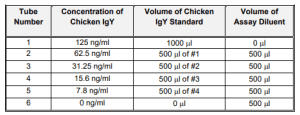
The Chicken IgY Standard is given at 125 ng/ml and ought to be weakened in Assay Diluent to set up a standard bend as displayed in the table underneath.
Example Dilutions
Chicken serum or plasma is assessed to have ~7 mg/ml of IgY. Chicken egg yolks have around 6-13 mg/ml of IgY. Along these lines, we suggest setting up a 1:250,000-300,000-overlap weakening in Assay Diluent for introductory testing. To lessen weakening blunder, three weakening advances are suggested. For instance, three 1:65-crease sequential weakenings, where 10l is added to 640l of Assay
Diluent, is a helpful weakening plan. Other example tests might contain pretty much IgY and should be weakened
properly. A 10-overlay weakening is normally adequate to keep away from conceivable network obstruction.
TEST PROCEDURE
Permit all reagents to arrive at room temperature before use. Plan reagents as portrayed previously. Name test cylinders to be utilized for the arrangement of norms and example tests. In the event that the whole microplate won’t be utilized for testing, eliminate excess takes from the plate casing and spot into the sealable plastic pack with desiccant. Seal sack and store at 2-8°C.
Stage 1: Label each strip on its end tab to guarantee character should the strips become separated from the plate outline during the
examine.
Stage 2: Pipette 200 l of norms 1-6 into copy wells.
Stage 3: Pipette 200 l of every example test into copy wells.
Stage 4: Cover the microplate with a plate sealer and brood for 30 minutes at room temperature (18-25˚C).
Stage 5: Aspirate the items in each well and wash multiple times with 1X Plate Wash Buffer (See Preparation of Reagents segment). To wash, fill the wells with somewhere around 300 l of 1X plate wash support and suction. Perform 4 fill/suction cycles.
After the last wash cycle, completely blotch the plate via cautiously striking on a stack of retentive paper towels. Proceed
striking until no noticeable drops of Plate Wash Buffer are noticed.
Stage 6: Pipette 100 l of Chicken IgY Detector Antibody into each well.
Estimation OF RESULTS
Test Validity:
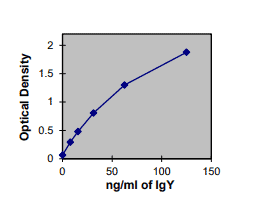
• The mean optical thickness of the 0 ng/ml standard should be beneath 0.200.
• The mean optical thickness of the 125 ng/ml should be above 1.000.
• It is suggested that example tests be re-examined with a more noteworthy or lesser weakening when the mean optical thickness esteem doesn’t fall inside the standard bend.
Estimation:
1. Ascertain the mean optical thickness (OD) values for each arrangement of principles and weakened example tests.
2. Utilizing direct chart paper or diagramming programming, plot the mean OD upsides of every norm on the Y-pivot versus the
comparing grouping of guidelines on the X-pivot.
3. Draw the best fit bend through these focuses to develop a standard bend. A highlight point development will be the generally precise.
4. Decide the IgY convergence of each weakened example test by introduction from the standard bend.
5. Duplicate by the weakening component used to weaken every example test to decide the IgY grouping of the first
example test.
Execution CHARACTERISTICS
Explicitness:
The chicken IgY locator counter acting agent in this pack has been shown by immunoelectrophoresis or potentially ELISA to respond just with the Fc piece of the Chicken IgY weighty chain however not with the Fab part of chicken immunoglobulins.
No responses to other nonimmunoglobulin serum proteins were recognized.
Serum from sheep, hare, rodent, jackass, goat, horse, ox-like, mouse and human had no response with this ELISA test.