
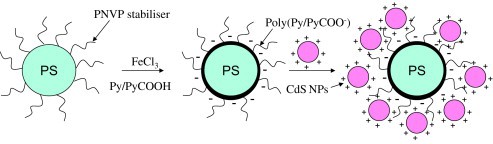
1. Carboxyl functionalized polystyrene particles (PS-COOH)
Our monodisperse polystyrene particles (or polystyrene copolymers) with carboxylic groups on the surface are prepared using various synthetic strategies such as the copolymerization of styrene with functional monomers or polymer-analogous reactions. These functionalized PS particles combine excellent monodispersity (CV <5%), the low adsorption of nonspecific proteins with high colloidal stability over a wide pH range. Using these carboxylic groups, many ligands (proteins, antibodies, etc.) can be coupled to the surface of the particle. Carboxylated PS particles are available with carboxylic group densities from 10 µmol / g to 100 µmol / g depending on the particle size.
2. To experience
2.1. Materials and instrumentation
Styrene (St) was purchased from Sinopharm. Methanol, ethanol, propanol, butanol, and pentanol were purchased from Beijing Chemical Corporation. Polyvinylpyrrolidone (PVP, Mw ~ 55000), Triton (TX-100), acrylic acid (AA), and 2,2-azobis- (2-methylbutyronitrile) (AMBN) were purchased from J&K Scientific Ltd. All reagents were used without further ado. purification.
A Tensor-27 Fourier Transform Infrared Spectroscopy (FTIR) manufactured in Bruker (Germany) was used to measure the content of carboxyl groups on the surface of carboxylated polystyrene. A Zeiss-Supra 55 Scanning Field Emission Electron Microscope (SEM) manufactured in Carl Zeiss (Germany) was used at operating voltages of 2 to 5 kV to observe the morphology of the particles. Molecular weight was measured by Waters-e2695 gel permeation chromatography (GPC) manufactured in Waters (America) and the carboxyl group was measured by Waters nuclear magnetic resonance (NMR) manufactured in Waters (America).
2.2. Synthesis of poly (St-co-AA) microspheres
Microspheres were prepared by two-stage dispersion polymerization. In the first step, the dispersant (PVP), co-dispersant (TX100), initiator (AMBN), monomer (St), and solvent were added to a 250 mL four-necked reaction flask equipped with a nitrogen inlet, thermometer, and a condenser. After a homogeneous solution was formed at room temperature, the solution was deoxygenated by bubbling nitrogen at room temperature for 10 min. The flask was then placed in a 70 ° C oil bath and subjected to mechanical stirring for h (h = 1–5) hour (s) at a speed of 180 rpm.
In the second step, AA was dissolved in a mixed solution of St equivalent and solvent equivalent at 70 ° C under a nitrogen atmosphere. After the first reaction time, the acrylic solution was added to a four-neck flask. The reaction was stopped after (24 h) hours of continuous reaction. After completion of the reaction, the sample was ultrasonically dispersed in ethanol and centrifuged; the supernatant was discarded. After washing three times, the sample was stored in a centrifuge tube and sealed with ethanol to prepare it for later use.
2.3. Characterization of carboxylated PS microspheres
The surface morphology and dispersion of the microspheres were characterized by scanning electron microscopy (SEM, ZEISS-SUPRA55). The molecular weight of the microspheres was measured by high-performance gel permeation chromatography (GPC). The surface carboxyl content of the microspheres was determined by the conductivity method. The mass of microspheres was weighed, ultrasonically dispersed in a sodium hydroxide solution of 25 mmol / L in concentration, and then set aside for 2 hours to allow complete reaction of the carboxyl and sodium hydroxide.

The sample was then titrated with a 9 mmol / L hydrochloric acid solution to determine the change in conductivity. The conductivity decreased with the addition of a hydrochloric acid solution, then tended to stabilize, before finally increasing. The conductivity decreased with an excess of sodium hydroxide. In this period, the neutralization reaction with hydrochloric acid and sodium hydroxide occurred.
3. Conclusion
Carboxylated PS microspheres are prepared by a two-step dispersion method using C1-C5 hydrocarbon alcohols as solvents. By changing the process conditions, the surface carboxyl content of the PS microspheres can be well controlled. The effect of the first step reaction time, solvent, and AA concentration on the carboxyl content on the surface of the PS microspheres is investigated.
The results show that the effect of the solvent on the carboxyl content of the PS microspheres is significant. When n-butanol is used as the solvent, the carboxyl content of the PS microspheres can reach 57.05 mg / g. The reaction time of the first step of the two-step method also has some influence on the carboxyl content on the surface of the microspheres, mainly reflected in the influence of the first reaction time on the nucleation process.
Carboxylated PS microspheres have important applications in biomedical detection, and achieving controllable surface carboxyl content for the microspheres lays a good foundation for advancing their application on biomedical dry slides.